Concrete & Stamped Concrete in Clark County, WA
Poured patios, walkways, slabs and stamped decorative concrete with correct base, thickness and control joints.
Get a Free EstimateConcrete is fast, clean and cost-effective for the right application. It is also unforgiving — a slab poured on poor base or without control joints in the right places will crack, and unlike pavers you cannot lift a piece and reset it.
Doing it properly
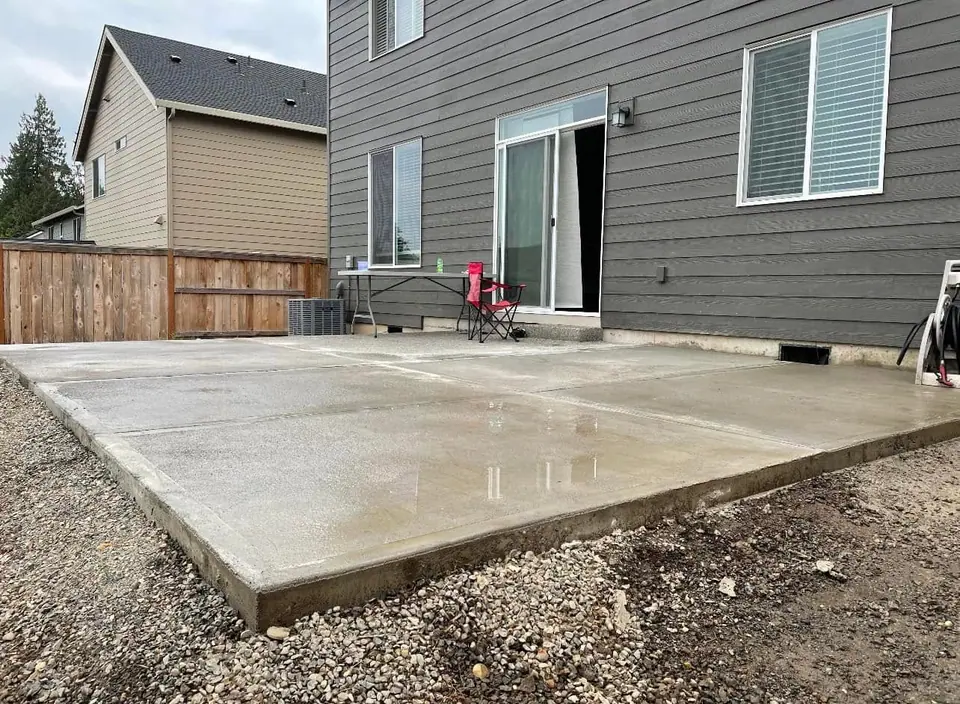
Compacted crushed rock base, proper thickness for the load, reinforcement where the design calls for it, and control joints cut at sensible spacing so the inevitable shrinkage cracking happens in a straight tooled line rather than randomly across the middle of your patio.
We isolate the slab from the house and from existing hardscape so the two can move independently, and we pitch every pour so water runs off rather than sitting in a birdbath.
Stamped and decorative
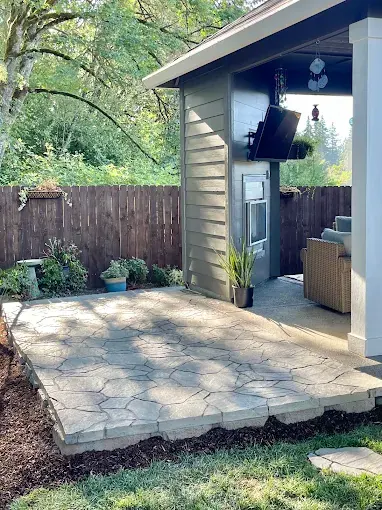
Stamped concrete gives you the look of flagstone, slate or cut stone in a single monolithic pour, usually at a lower cost than natural stone. It needs resealing every few years to keep the color from fading and to keep the surface from getting slick, which is a real consideration in our wet season — we use a finish with grit in high-traffic and sloped areas.
What is included
- Compacted crushed rock base under every pour
- Correct slab thickness for the intended load
- Reinforcement where the design requires it
- Tooled or saw-cut control joints at proper spacing
- Isolation joints at the house and existing hardscape
- Pitched for positive drainage
Every quote is fixed and in writing. We walk the site, tell you what the job actually needs, and price it. If we find something during the walkthrough that changes the scope, you hear it then — not as a change order halfway through.
Need concrete & stamped concrete?
Free on-site estimates across Clark County. We walk the property with you, tell you what it actually needs, and put a fixed price in writing.
Concrete & Stamped Concrete: common questions
Will my concrete crack?
All concrete cracks — it shrinks as it cures. The job of a good installer is to control where it happens by placing joints correctly so the cracks land in the tooled lines instead of across the open field. Base preparation is the other half; slabs on soft or uncompacted ground crack regardless of joints.
How long before I can use a new concrete patio?
Foot traffic after about 24 to 48 hours depending on weather. Furniture after a week. Keep vehicles off a new driveway slab for a month. Concrete keeps gaining strength for weeks after it looks finished.
How often does stamped concrete need sealing?
Roughly every two to three years in our climate. Our wet winters and summer UV are both hard on sealer, and a maintained seal is what keeps the color from washing out.
What goes under a concrete slab?
A compacted aggregate base over prepared subgrade, and on soft or poorly draining ground a geotextile separation layer as well. Concrete is strong in compression and weak in tension, so it does not bridge soft spots — it cracks over them. Almost every badly cracked slab we are asked to replace failed underneath, not in the mix.
What are control joints and why do they matter?
They are tooled or sawn lines that deliberately weaken the slab in a straight line so the inevitable shrinkage crack happens there instead of wandering across the middle. Spacing and depth are what make them work. A slab with joints placed too far apart or cut too shallow will crack wherever it likes.
What is an isolation joint?
A compressible separation where the new slab meets the house, an existing patio, a step or a post. It lets the two move independently, because they will. Pour a patio hard against a foundation with no isolation and the slab either cracks along that edge or transmits movement into something you care about more.
Should the concrete have rebar or mesh?
Reinforcement does not stop concrete cracking — it holds the crack tight and stops the two sides going their separate ways. Whether a residential slab needs mesh, rebar or fibre depends on thickness, loading and what is underneath. It is not a substitute for a properly compacted base, and it is often sold as though it were.
Can concrete be poured in our winter?
Rain is manageable with planning; a hard freeze during the first days of curing is not, because concrete that freezes before it gains strength is permanently weakened. We will pour through most of the wet season and stand down for a cold snap. If a pour needs to move, we tell you rather than gamble with your slab.
How long does concrete take to cure properly?
It is walkable in a day or so and takes vehicle traffic considerably later, but full strength develops over roughly a month. Curing is a chemical reaction, not drying out, which is why keeping a fresh slab from losing moisture too fast matters more than most people expect.
What is stamped concrete and how does it hold up here?
Fresh concrete impressed with a texture and colour to imitate stone, slate or timber. It looks good and it is a continuous surface, but it is still one rigid slab, and the colour is a surface treatment that wears in traffic and fades in sun. In our climate it also needs resealing on a cycle to keep looking right.
Is stamped concrete slippery when wet?
It can be, particularly once it has been sealed, and that is worth thinking about seriously on anything with a slope or near a step. A grit additive in the sealer helps considerably. On a shaded, north-facing surface that stays damp for seven months, texture matters more than pattern.
Can you colour-match or repair existing concrete?
Patching concrete is honest work but it will always show. Concrete cures to a colour that depends on the mix, the weather that week and years of weathering, so a new patch beside an old slab is visible. Where appearance matters, replacing a whole bay between joints usually looks far better than a repair.
Can concrete be poured over an existing slab?
An overlay is possible on a sound slab, but if the existing concrete is cracked or moving, the new surface will crack in the same places within a couple of years — it simply telegraphs through. Where the old slab has failed because of what is under it, the fix is removal and a proper base.
Concrete or pavers for a driveway?
Concrete gives a smooth continuous surface and takes vehicle loads well; pavers flex with seasonal ground movement, can be lifted for utility access and are repairable unit by unit. On ground that moves through our wet and dry cycle, pavers are more forgiving. On a stable, well-drained site, either works.
How thick should a residential slab be?
It depends entirely on use — a patio that carries people is a different specification from a driveway carrying vehicles or an RV. Thickness, base depth and reinforcement get decided together, not separately. We size it for what will actually be on it, including the vehicle you have not bought yet if you tell us about it.
Does concrete need to slope, and how much?
Yes — a definite, consistent fall away from the house, enough to shed water without being noticeable underfoot. A dead-flat slab holds water in every slight hollow, and in a climate this wet that means algae, staining and a slick surface all winter.
How long does a concrete project take?
Preparation is most of the calendar and the pour is often a single morning. Demolition and removal of an old slab, excavation, base and forming typically run several days, then the pour, then curing time before you can use it. The finishing window on pour day is short and weather-dependent, which is why we do not stack two pours in a day.
What causes the white haze on concrete?
Efflorescence — soluble salts carried to the surface as moisture moves out of the slab, then left behind when it evaporates. It is cosmetic, extremely common in wet climates, and usually weathers off over the first year or two. It is a sign of moisture movement, not of a bad pour.