Pergolas & Outdoor Living in Clark County, WA
Pergolas, outdoor kitchens, fire pits and seat walls that turn a patio into a room you actually use.
Get a Free EstimateOur outdoor season is short enough that it is worth extending. Cover, heat and a place to cook are what turn a patio you look at into a space you use from April through October.
Pergolas and cover
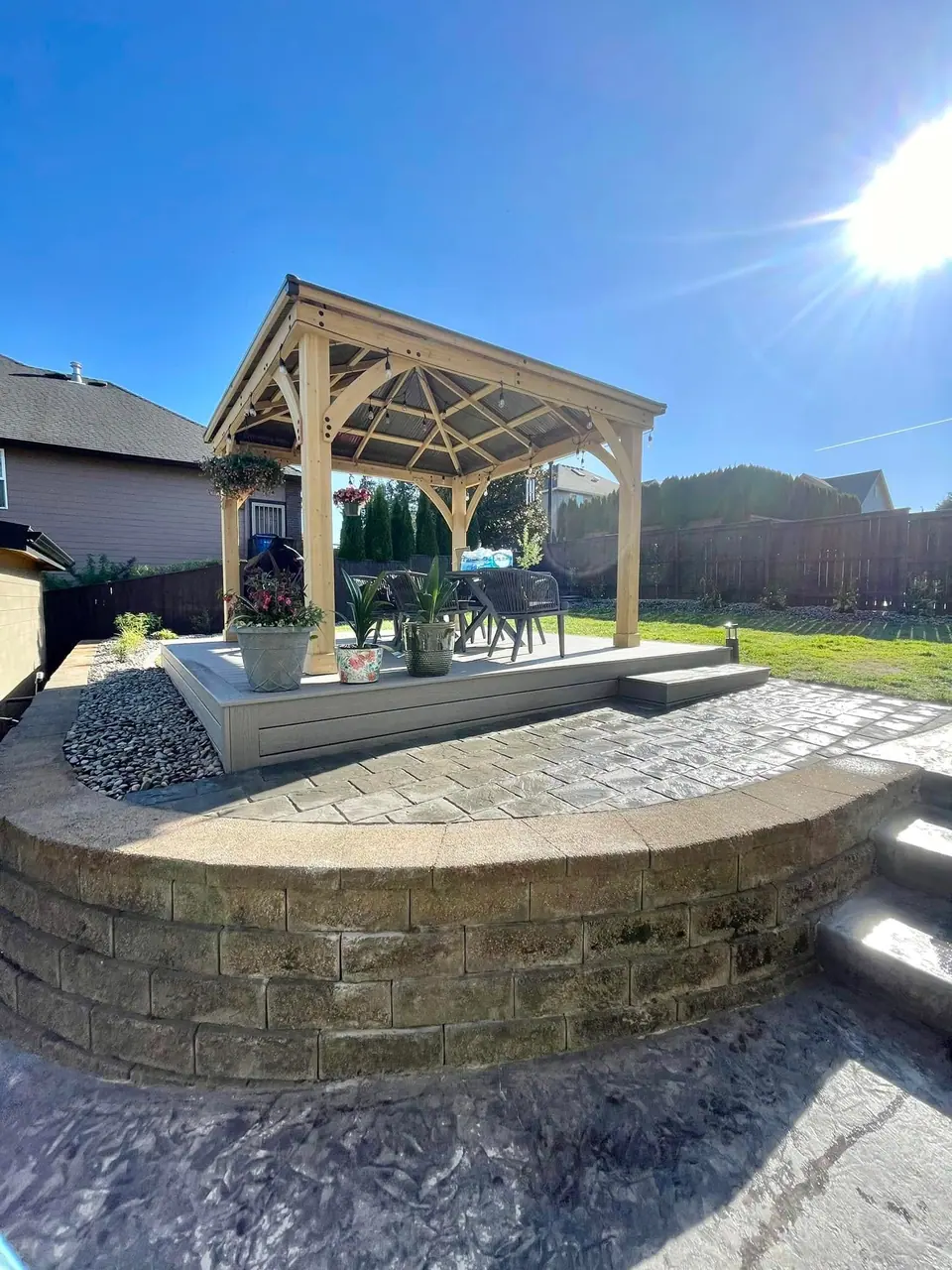
A pergola defines an outdoor room and carries lighting, heaters, fans and shade. We build in cedar and heavy timber, on footings sized for our soil and the wind loads that come up the Columbia River Gorge. Open-slat for filtered light, or solid-roofed if you want to sit out in October rain.
Kitchens, fire and seating
Built-in grill islands and counters, framed and faced in stone or veneer with weather-rated components. Wood-burning and gas fire pits, and gas fire tables built into seat walls. Seat walls that double as retaining structure and give you permanent seating without furniture to store every winter.
We run gas, water and electrical sleeves under the hardscape before it is laid — retrofitting utilities under a finished patio means cutting it up, so we plan for it even when the feature comes in a later phase.
What is included
- Cedar and heavy timber pergolas on proper footings
- Solid-roof options for shoulder-season use
- Built-in grill islands and counters
- Wood and gas fire pits and fire tables
- Seat walls integrated with retaining structure
- Utility sleeves run before hardscape goes down
Every quote is fixed and in writing. We walk the site, tell you what the job actually needs, and price it. If we find something during the walkthrough that changes the scope, you hear it then — not as a change order halfway through.
Need pergolas & outdoor living?
Free on-site estimates across Clark County. We walk the property with you, tell you what it actually needs, and put a fixed price in writing.
Pergolas & Outdoor Living: common questions
Does a pergola need a permit?
It depends on size, height, whether it is attached to the house and whether it has a solid roof. Freestanding open structures under a certain footprint are often exempt, but attached and roofed structures generally are not. We will tell you which category yours falls into so you can confirm with your building department.
Can we use it in the rain?
Only with a solid roof. An open-slat pergola gives shade and definition but not weather protection. If you want to sit outside in a Pacific Northwest November, you want a solid roof and a heat source, and we will design for that from the start.
Should the fire pit be gas or wood?
Gas lights instantly, produces no smoke, needs no cleanup and can go where burn restrictions apply. Wood costs far less to build and gives the fire people actually want. Check your local burn rules and HOA before deciding — some Clark County neighborhoods restrict open burning.
What is the difference between a pergola, an arbour and a pavilion?
A pergola is an open-roofed structure with rafters that gives partial shade and supports climbing plants; an arbour is a smaller feature, usually over a gate or path; a pavilion has a solid roof and gives genuine shelter from rain. In a climate this wet, the choice between open and solid roof decides whether the space is usable in November.
Will a pergola keep the rain off?
An open-rafter pergola will not, and that is worth being clear about before you build one here. It gives shade, structure and a sense of enclosure. If you want to sit outside during our long wet season, you need a solid roof or a proper cover system — which is a bigger structure and usually a different permitting question.
What footings does an outdoor structure need?
Posts on proper footings sized for the structure and the ground, below the depth that moves seasonally. Structures sitting on pavers or shallow blocks move as the ground wets and dries through the year, and once a post moves the whole frame racks. It is the least visible part of the job and the one that decides whether it stays square.
Should a structure be attached to the house or freestanding?
Attached saves material and can look more integrated, but it puts load onto the house and creates a junction that has to be flashed properly or it will leak. Freestanding avoids both problems and is often simpler to permit. We usually talk this through early, because it changes the design and sometimes the paperwork.
How close can a fire pit be to the house or a fence?
Further than most people put it. Heat, embers and smoke all need clearance from siding, eaves, fences and overhanging branches, and a wood fire needs considerably more than a gas feature. Local rules on open burning and fire seasons apply too. We site it with the prevailing wind in mind so the smoke does not sit on the patio.
Can I have a fire pit on a paver patio?
Yes, and it is the right surface for it. What we do not do is put a fire feature straight onto artificial turf or timber decking. Where a fire pit is going in later, tell us during the patio build so the base and layout account for it rather than being cut up afterwards.
What is involved in an outdoor kitchen?
A framed and clad structure on a solid base, counter surfaces that survive being wet for seven months, and services — gas, power, sometimes water and a drain — run before the hardscape goes down. The appliances are the easy part. Getting the utilities in the right place at the right time is what makes or breaks the project.
Does an outdoor kitchen work in this climate?
It does if it is designed for the weather rather than for a catalogue photograph. That means cover over the cooking area, materials and cabinetry rated for continuous damp, and somewhere for water to go. Unprotected outdoor kitchens here look tired within a few seasons.
What about outdoor lighting?
Low-voltage lighting transforms how much a space actually gets used, because it is dark by half four in midwinter. Path lights, step lights and uplighting into trees do most of the work. Sleeves and conduit want to go in before hardscape and planting, which is why it belongs in the plan even if you fit it later.
Can you build a seat wall instead of buying furniture?
Yes, and around a fire pit or the edge of a patio it works very well — permanent seating that never blows over, needs no storage and doubles as retaining or a planter. Comfortable seat height and depth are what make the difference between a wall people sit on and a wall people ignore.
What is the best surface under an outdoor living area?
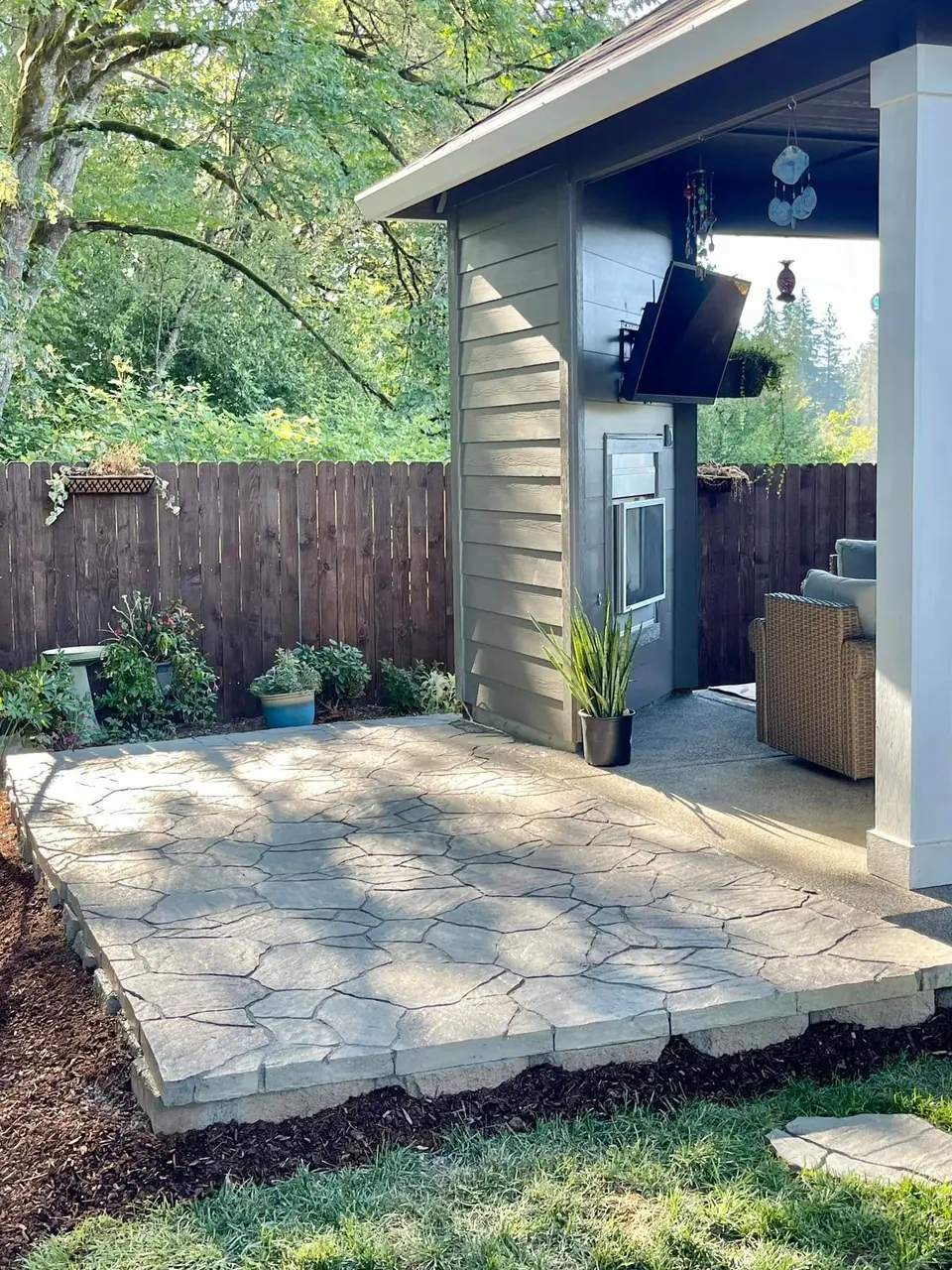
Something that drains, has grip when wet and can carry the load of a structure and its footings. Pavers and concrete both work; the decision usually comes down to how the ground behaves and whether you want a flexible or a rigid surface. What does not work is building a structure onto a surface that was never designed to hold it.
Can you add heating so we can use it more of the year?
Overhead or wall-mounted heaters, or a fire feature, extend the season noticeably — but only under cover. Heating an open pergola in November is heating the outdoors. If year-round use is the goal, the roof decision matters far more than the heater decision.
How long does an outdoor living project take?
A pergola over an existing patio can be under a week. A full build — patio, seat walls, fire feature, structure, kitchen and lighting — runs several weeks, and services and any permitting have to be sequenced at the front. These projects are as much about order of operations as about construction.
Can we build it in phases?
Yes, and it is often the sensible way to do it. The key is doing the buried work once — footings, sleeves for power and gas, drainage and base — so that phase two does not mean cutting into a finished patio. Phasing costs very little extra if it is planned; it costs a lot if it is improvised.
What maintenance do outdoor structures need here?
Timber needs a finish maintained on a cycle or it weathers and eventually degrades; fixings and hardware want checking for corrosion in constant damp; and gutters or roof surfaces on covered structures need clearing every autumn. None of it is heavy, but a structure left entirely alone in this climate ages quickly.