Paver Patios & Walkways in Clark County, WA
Interlocking paver patios, walkways and driveways built on an open-graded base that survives Clark County winters.
Get a Free EstimateA paver patio is only as good as what is underneath it. Most of the failed patios we get called out to repair in Clark County look fine the day they were finished — they sank two winters later because somebody laid pavers on four inches of loose sand over clay. We build the base first and the pretty part second.
How we build a patio that stays flat
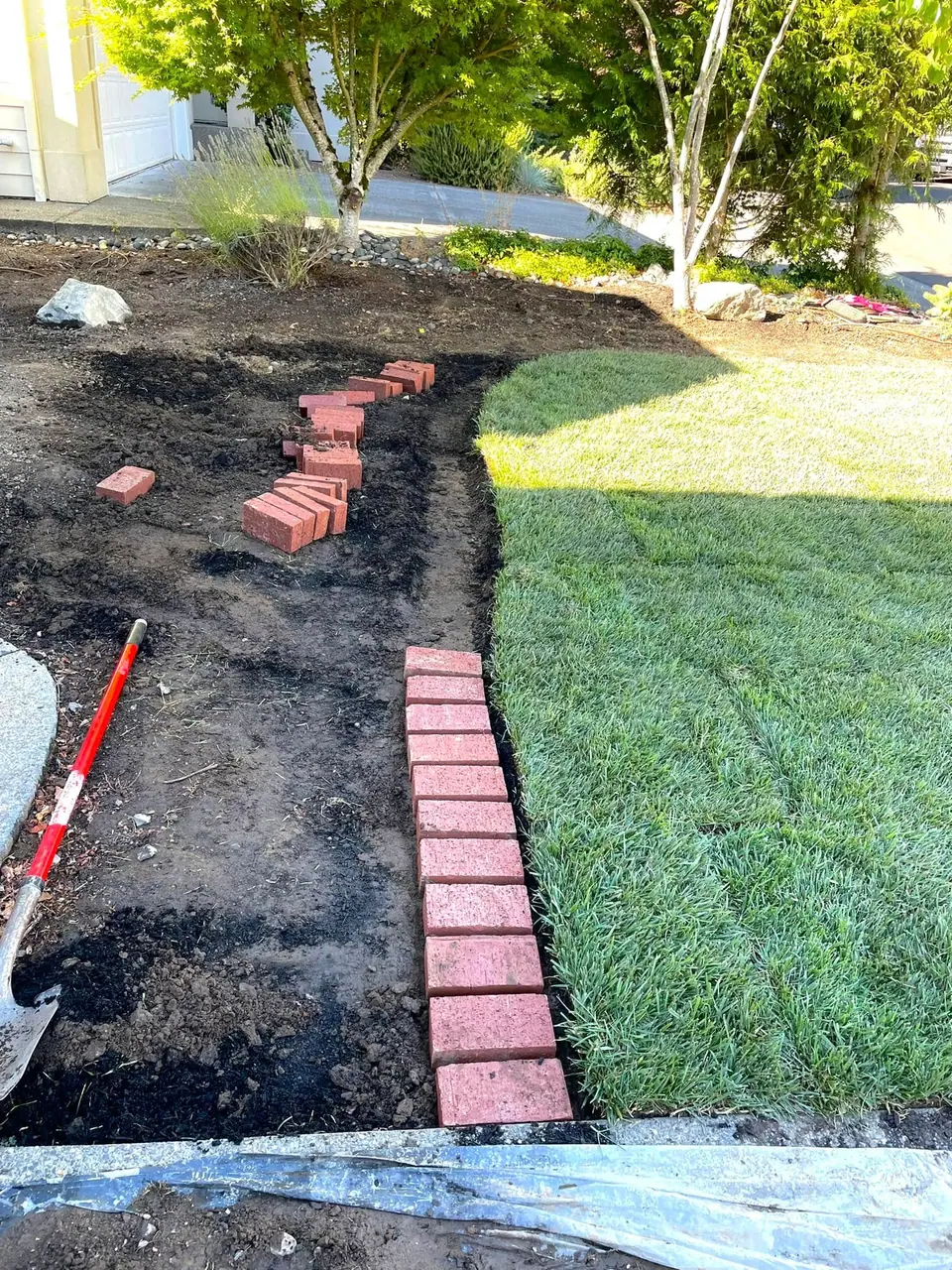
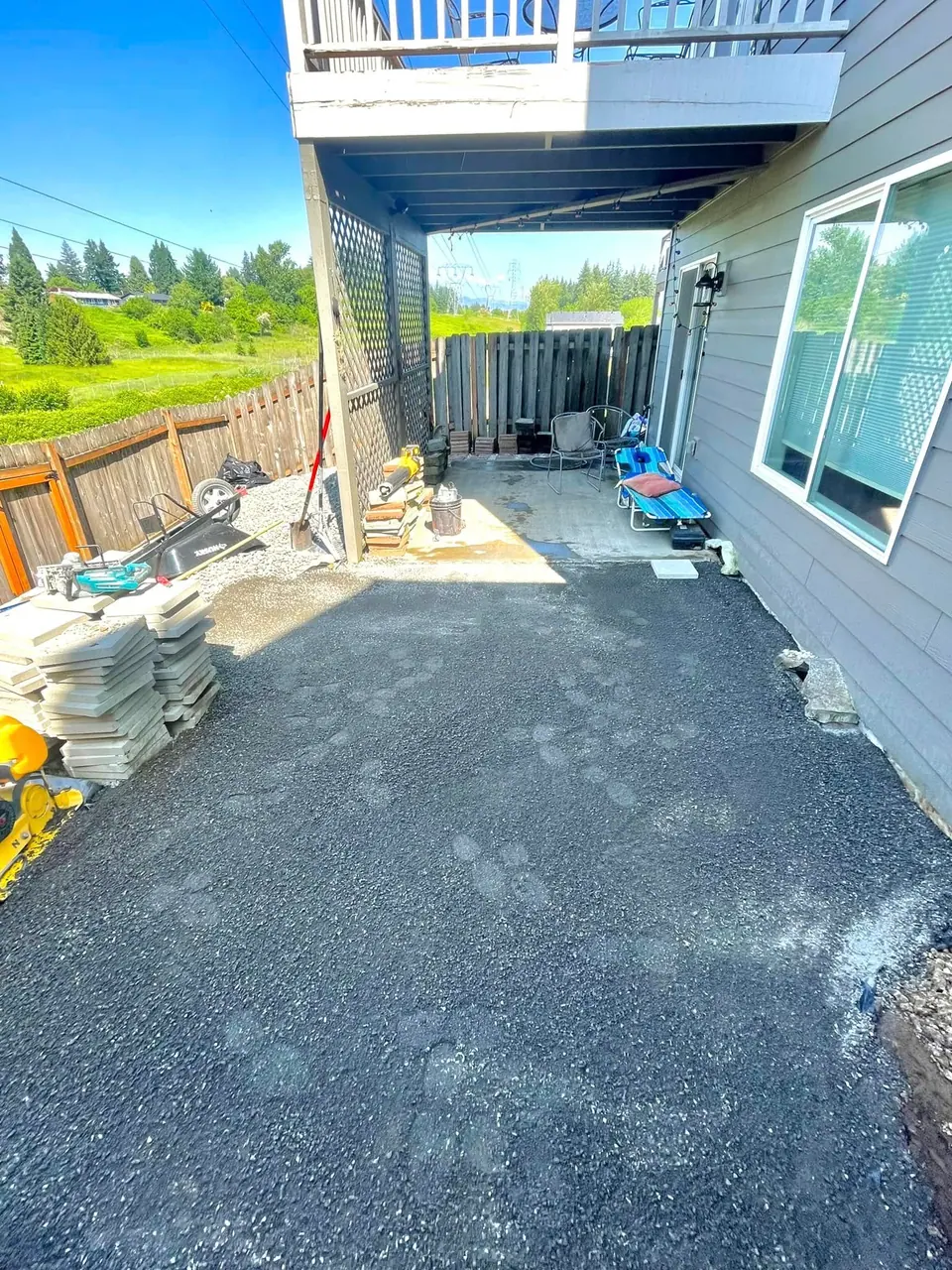
We excavate to subgrade, which in most Clark County yards means digging out 8 to 12 inches of native clay for a patio and more for anything a vehicle drives on. That clay is then compacted and, on wet sites, separated from the new base with a woven geotextile so the two never mix.
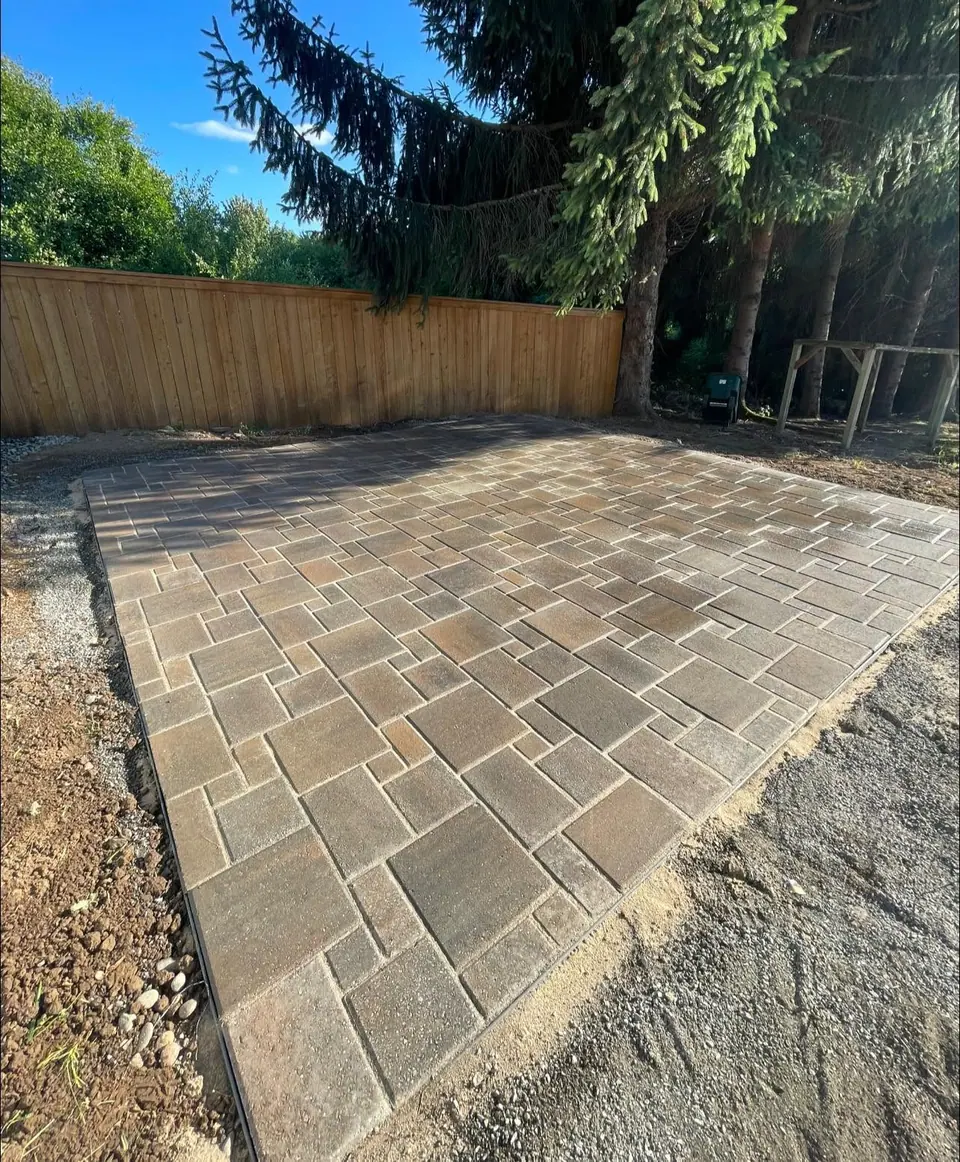
Base rock goes in as compacted lifts rather than one deep dump, because a plate compactor only densifies the top few inches at a time. We screed a thin bedding course, lay the field, cut the perimeter with a saw rather than a guillotine for clean edges, and lock the whole thing in with a spiked edge restraint. Joints get polymeric sand, compacted and set.
The finished surface is pitched away from your foundation — usually around a quarter inch per foot. That slope is not optional here. Water that cannot leave a patio will get under it, and in a freeze it will lift it.
What we install
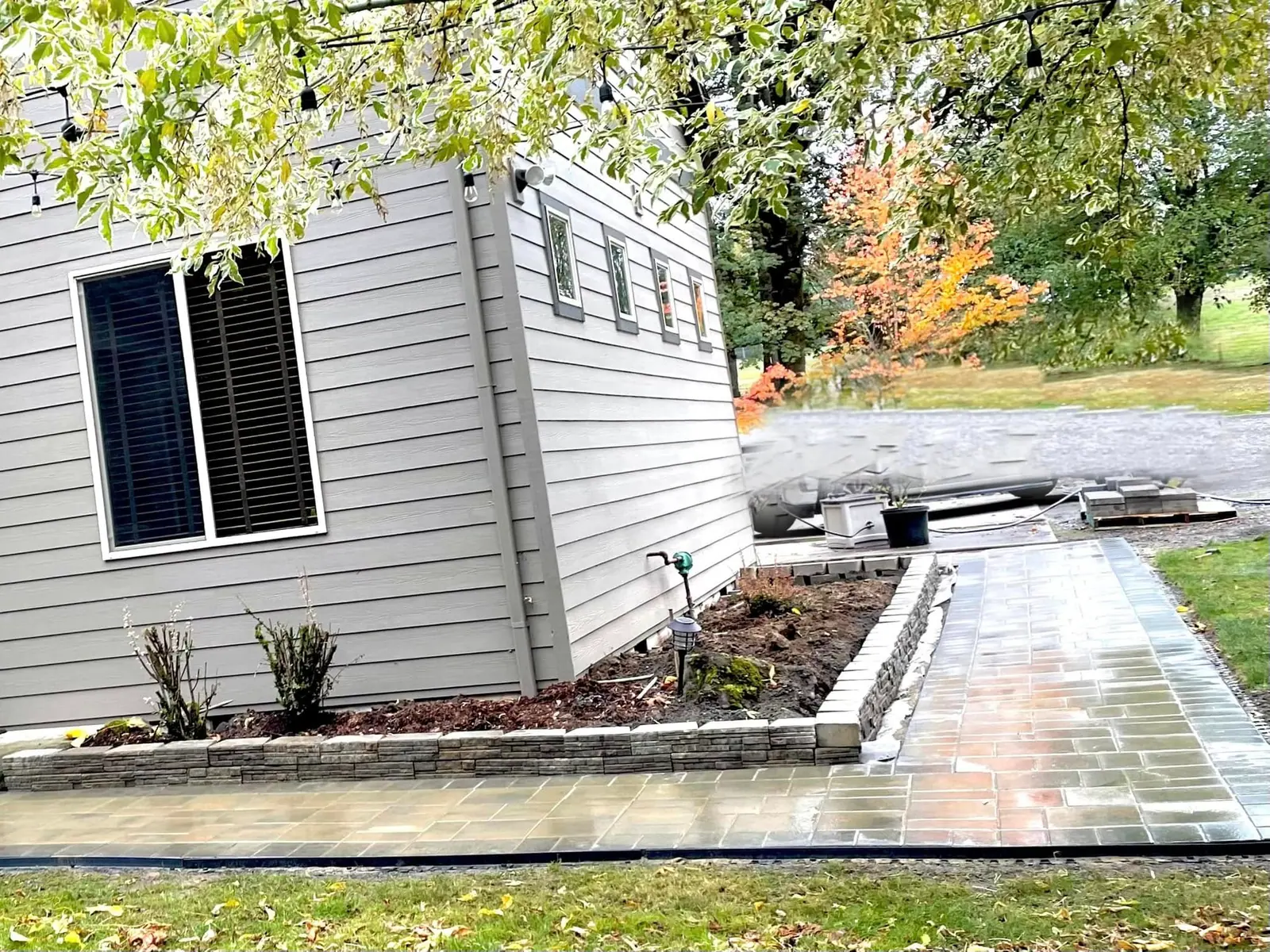
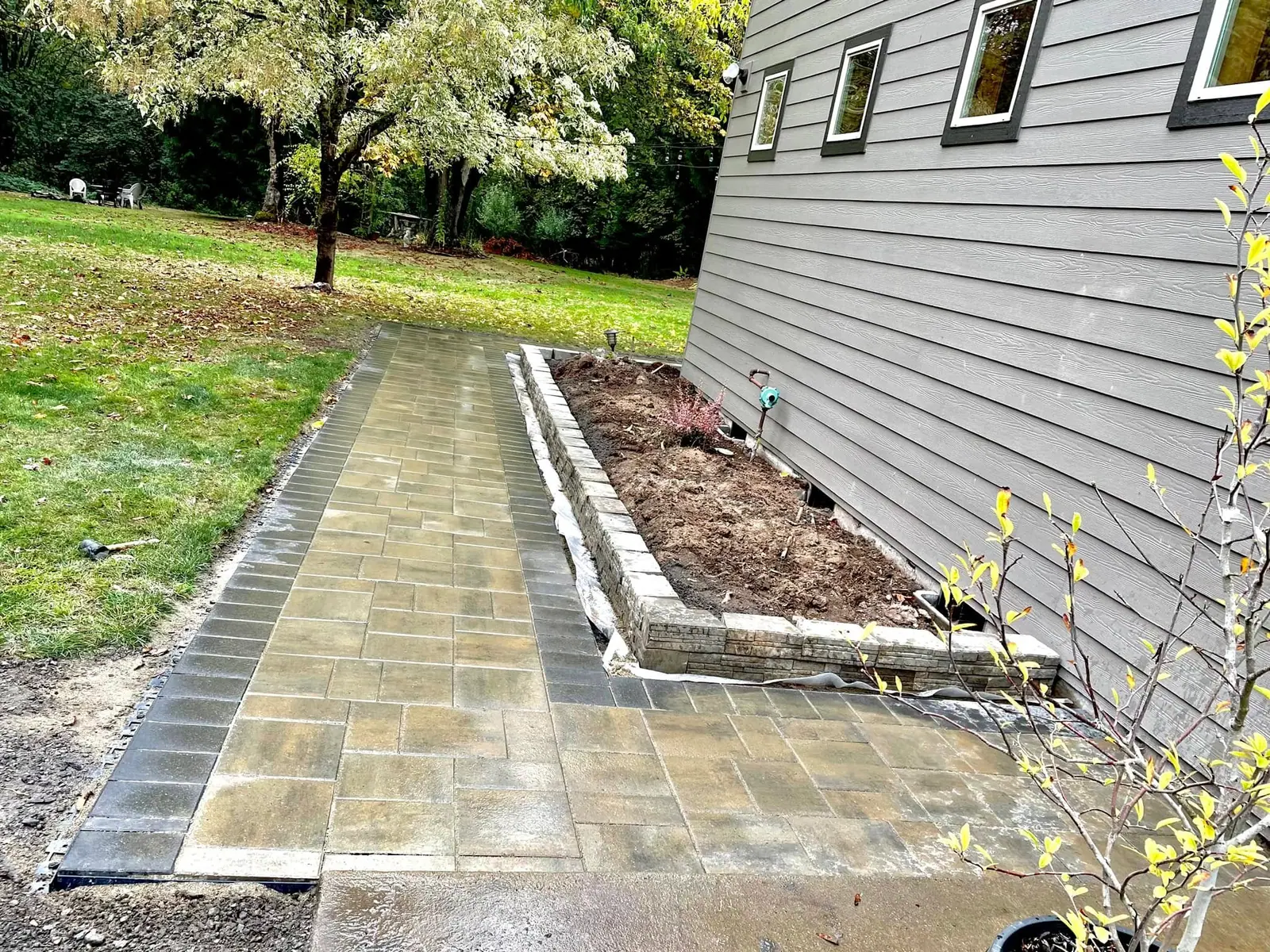
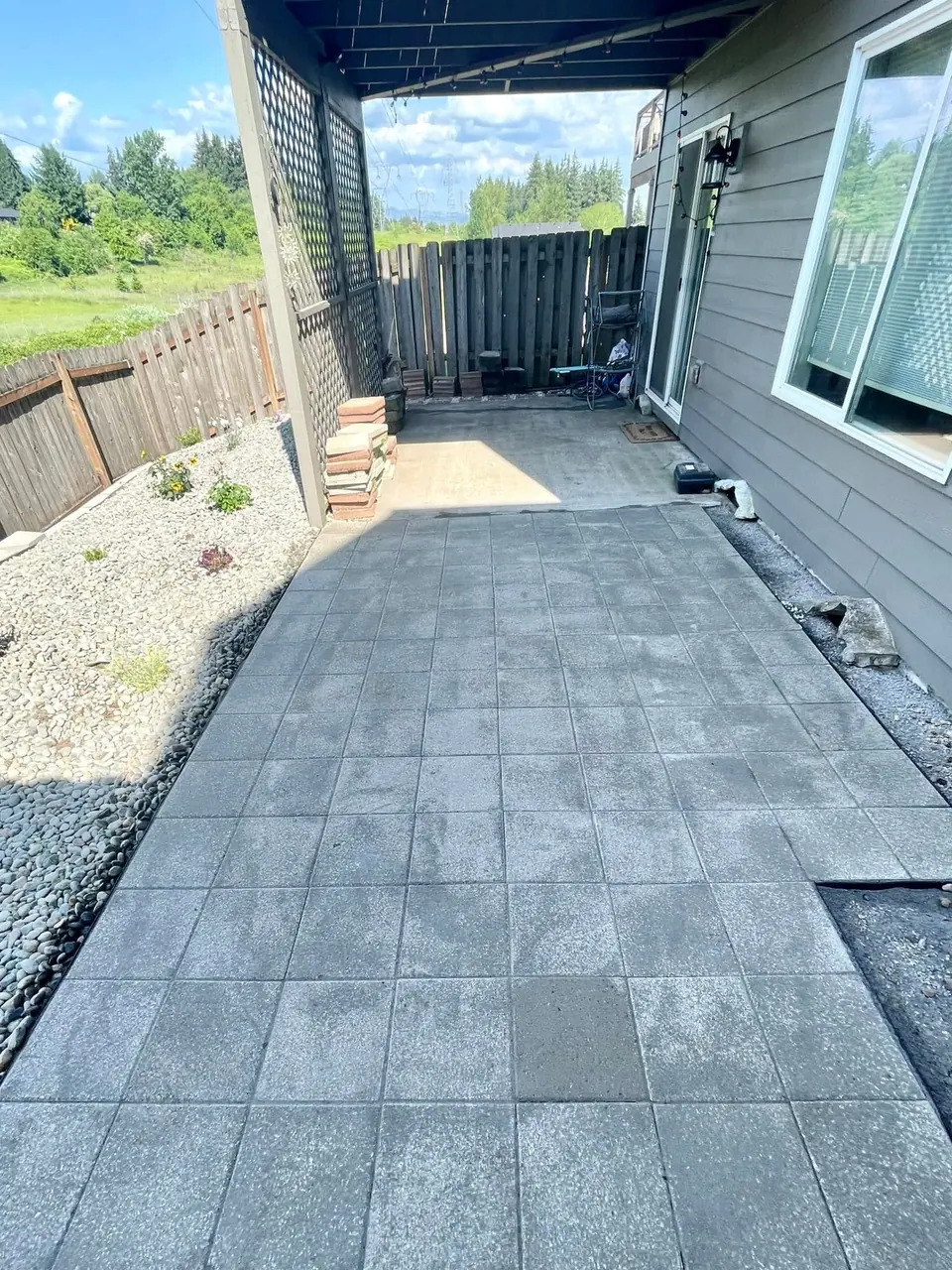
Patios and seating areas, front entries and walkways, driveways and RV parking aprons, pool surrounds, seat walls and steps, tree rings and border banding. We work with standard concrete pavers, large-format slabs, permeable systems and natural stone.
What drives the price
Square footage matters less than people expect. The bigger cost drivers are access (whether a machine can reach the back yard or everything moves by wheelbarrow), how much material has to be hauled off, base depth for the intended load, cuts and curves, and whether the job includes steps or walls. We walk all of that with you and put a fixed number in writing.
What is included
- Excavation to proper subgrade for the intended load
- Geotextile separation fabric on clay and wet sites
- Compacted base in lifts, not a single deep pour
- Saw-cut perimeter and spiked edge restraint
- Polymeric jointing sand, compacted and set
- Positive drainage pitched away from the house
Every quote is fixed and in writing. We walk the site, tell you what the job actually needs, and price it. If we find something during the walkthrough that changes the scope, you hear it then — not as a change order halfway through.
Paver Patios & Walkways by city
Local conditions change what this job takes. Pick your area for the specifics.
Need paver patios & walkways?
Free on-site estimates across Clark County. We walk the property with you, tell you what it actually needs, and put a fixed price in writing.
Paver Patios & Walkways: common questions
How long does a paver patio take to install?
A typical 400 to 600 square foot residential patio runs three to five working days once we start, assuming reasonable access and no weather delays. Larger builds with walls, steps or an outdoor kitchen run one to three weeks.
Pavers or stamped concrete — which is better here?
Pavers, in most Clark County yards. Our ground moves seasonally as it wets and dries, and a poured slab is one rigid piece that cracks when the ground under it shifts. A paver field is thousands of small pieces that flex with the ground and can be individually lifted and reset. Stamped concrete looks great and costs less up front, but it is far harder to repair.
Do I need a permit for a patio?
A ground-level patio usually does not require a building permit, but jurisdictions in Clark County differ, and impervious surface limits, setbacks, easements and HOA rules can all apply. If your project touches any of those we will tell you during the walkthrough so you can confirm with your city or the county before we start.
Will weeds grow through the joints?
Not from below, if the base is built right. What people see is windblown seed germinating in the top of the joint sand. Polymeric sand, kept topped up every few years, handles almost all of it.
Can you install pavers over an existing concrete slab?
Sometimes. If the slab is structurally sound, drains properly and the added height does not create a problem at doors or thresholds, an overlay can work and saves demolition cost. If the slab is already cracked or holding water, we take it out.
How deep does the base under a paver patio need to be?
For a residential patio on decent ground we build on a compacted crushed rock base, typically in the six-inch range, placed and compacted in lifts rather than dumped and rolled once. On soft or poorly drained ground it goes deeper and gets a geotextile separation layer underneath. The base is the patio — the pavers are just the surface you look at.
Why do paver patios sink or go uneven?
Nearly always base failure, not paver failure. Either the base was too thin, it was compacted in one thick layer instead of lifts, or it was built over soft subgrade with no geotextile to stop the rock migrating down into it. Our wet season makes all three worse, because saturated ground under an under-built base moves.
What stops the edges of a patio from spreading?
A proper edge restraint pinned into the base around the perimeter. Without it the outer courses creep outward every time the patio is loaded, the joints open, and the sand washes out — which is why so many older patios have a ragged, gappy edge. It is a small part of the cost and the first thing we look at on a failing patio.
Do pavers move in a freeze?
Far less than a poured slab does. We sit in zone 8b, where winter lows average about 15 to 20°F, so we get freeze-thaw cycles rather than deep sustained frost. A flexible paver surface over a free-draining base absorbs that movement across thousands of joints; one rigid slab has to crack somewhere to relieve it.
Should I seal my pavers?
It is optional and it is a commitment rather than a one-off. Sealing deepens the colour and makes spills easier to lift, but it needs redoing every few years and a sealed surface can be slicker underfoot in the wet. Plenty of our patios are never sealed and look right a decade on.
How do I clean a paver patio in this climate?
Most of what grows here is surface algae and moss from seven months of damp shade, and it comes off with a stiff brush and a suitable cleaner. Go carefully with a pressure washer — too much pressure blasts the jointing sand straight out, which is what opens the door to weeds and ants the following year.
Can a single damaged paver be replaced?
Yes, and it is one of the real advantages over concrete. A stained, chipped or oil-marked unit lifts out and a replacement drops into the same space. We generally leave you a small stock of spares from the same batch, because dye lots shift over the years and an exact match later is not guaranteed.
Can you build a paver driveway, not just a patio?
Yes, but it is a different build. Driveway work carries vehicle loads, so it needs a deeper compacted base, a thicker paver rated for traffic, and a laying pattern such as herringbone that interlocks under turning loads. A patio base under a driveway will rut where the wheels track.
How much fall does a patio need for drainage?
Enough to move water off the surface and away from the house — a slight, consistent pitch you will not notice underfoot but which stops water standing after a downpour. Flat is not level in practice; a patio built dead flat holds sheets of water every November and grows moss along the low edge.
How close to the house can a patio be built?
It can meet the house, but it has to sit well below the siding and any weep or vent line, and it has to pitch away. The failure we get called out to fix is a patio built up too high against a wall, which turns a nice sitting area into a route for water into the crawl space.
Can you extend or match an existing patio?
Often, though you should expect a visible difference. Pavers weather and dye lots change, so a ten-year-old surface will not match new stock exactly. Sometimes the better answer is a deliberate contrast — a different but complementary paver for the extension — rather than a near-match that reads as a mistake.
Do pavers get slippery or grow moss here?
Any hard surface in a shaded, wet Pacific Northwest yard will pick up algae and moss over the winter. Texture is what matters: a lightly textured paver keeps grip far better than a smooth or heavily sealed surface. Where a patio sits under conifers on the north side of a house, we will say so up front and spec accordingly.
Can we add a seat wall, steps or a fire pit later?
Yes, and it is much cheaper if we know now. Tying a wall or fire feature into an existing patio means cutting the field and building a footing under it. If you tell us at the walkthrough that it is a phase two, we set the base and the layout so the later work drops in cleanly.
What goes in the joints between the pavers?
Polymeric jointing sand, swept in and set. It locks the units together, keeps the surface stable and resists washout far better than plain sand, which our rainfall moves out of open joints surprisingly fast. It is not permanent — expect to top up joints once in the life of the patio.
How long will a paver patio last?
The pavers themselves outlast most of the house. What determines whether the patio still looks right in twenty years is the base under it and the edge restraint around it — which is precisely why we spend the money below ground where you cannot see it rather than on a thicker paver.