Ponds & Water Features in Clark County, WA
Ponds, pondless waterfalls and bubbling features built with proper liner, filtration and circulation.
Get a Free EstimateA well-built pond is the feature people remember about a yard. A badly built one is a green, smelly maintenance problem that the owner eventually fills in. The difference is circulation, filtration and edge detail — decided before anyone digs.
What makes a pond work
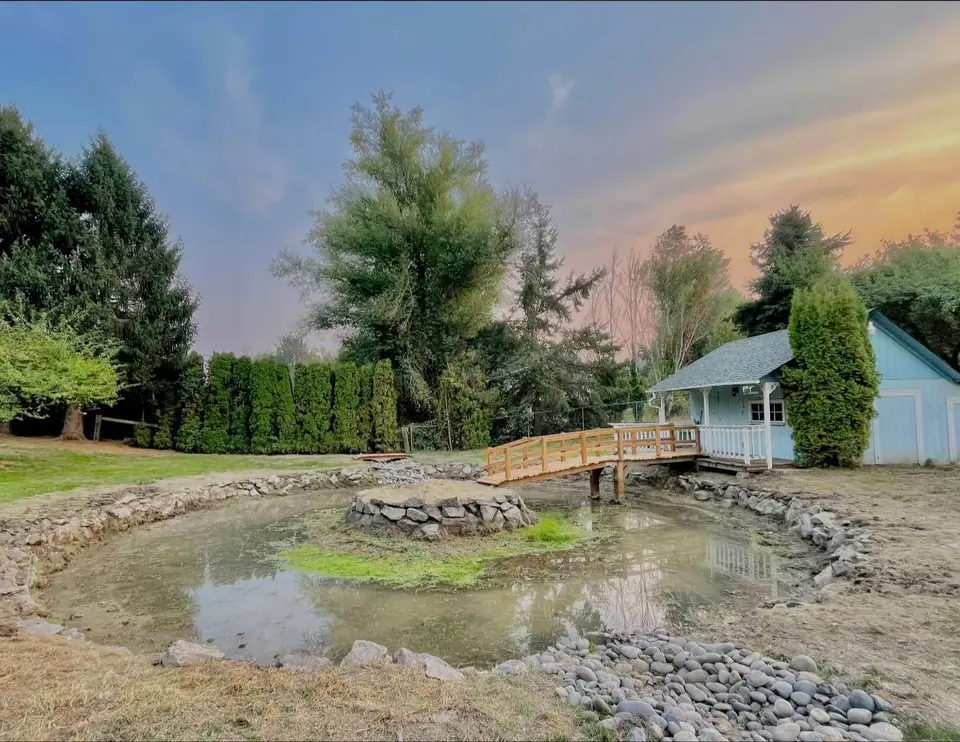
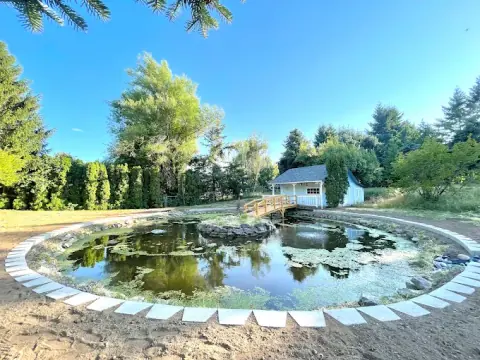
Adequate depth so the water stays stable through summer heat and winter cold. Enough circulation to turn the full volume over regularly. Mechanical and biological filtration sized to the actual volume and fish load, not to the pump box. And a liner and edge detail that hides the liner completely, because a visible black rim ruins the illusion instantly.
Pondless options
If you want the sound of moving water without open water to maintain — or you have small children — a pondless waterfall or a bubbling boulder recirculates from a hidden underground reservoir. Far less maintenance, no drowning risk, no algae management, and it can be switched off seasonally.
What is included
- Depth and volume planned before excavation
- Circulation sized to turn over the full volume
- Mechanical and biological filtration
- Fully concealed liner and natural stone edging
- Pondless waterfall and bubbler options
- Integrated with surrounding planting
Every quote is fixed and in writing. We walk the site, tell you what the job actually needs, and price it. If we find something during the walkthrough that changes the scope, you hear it then — not as a change order halfway through.
Need ponds & water features?
Free on-site estimates across Clark County. We walk the property with you, tell you what it actually needs, and put a fixed price in writing.
Ponds & Water Features: common questions
How much maintenance is a pond?
A properly built and planted pond needs a seasonal cleanout, periodic filter rinsing and topping up for evaporation in summer. That is genuinely manageable. Ponds that need constant intervention are almost always undersized on filtration or circulation from day one.
Will it freeze in winter?
Clark County winters rarely freeze a pond of adequate depth solid. A small de-icer or an aerator keeps a gas exchange hole open in a hard cold snap, which is what fish actually need.
Can you fix or renovate an existing pond?
Often, yes. Most of the failing ponds we look at have a sound basin and a liner that is fine — the problems are undersized filtration, poor circulation, or an edge that lets soil and lawn runoff wash in. Those are usually fixable without starting over.
What is a pondless waterfall?
A waterfall and stream where the water disappears into a hidden gravel reservoir at the bottom instead of collecting in an open pool. You get the sound and movement of running water with no standing water, which means no drowning risk for small children, far less maintenance and no fish to look after. For a lot of families it is the better answer.
How deep does a pond need to be?
It depends what lives in it. A purely ornamental pool can be shallow; a pond keeping fish through the winter needs enough depth for a stable zone at the bottom. Our winters are mild enough that depth is more about the fish having somewhere settled than about the pond freezing solid.
Do I need a filter and a pump running all the time?
A pond with fish needs continuous circulation and filtration — the biological filter is a living colony and it dies if you switch it off for long stretches. A pondless feature can be run only when you want to hear it. That difference in running cost and commitment is worth understanding before you choose.
How much does a water feature cost to run?
The pump is the ongoing cost and it varies enormously with the volume of water you are moving and how high you are lifting it. A modest bubbler is trivial to run; a large waterfall circulating continuously is not. We size the pump to the feature rather than oversizing it, because an oversized pump costs money every day of its life.
Why does my pond water go green?
Algae, and it is a balance problem rather than a cleanliness problem. Too much sun, too many nutrients from fish waste or run-off, and not enough planting or filtration, and algae takes the opportunity. The durable fixes are shade, plant cover across part of the surface, correct stocking levels and adequate filtration — not repeated chemical treatment.
Will a pond attract mosquitoes?
Moving, circulated water does not — mosquitoes need still water to breed. A pond with a pump running, or a pondless waterfall, is a poor mosquito habitat. Neglected water features with a dead pump are a different matter entirely.
Will herons or raccoons take the fish?
They will if the pond makes it easy. Herons are patient and effective, and we see them across the county wherever there is water. Depth, steep-sided sections, planting cover and somewhere for fish to hide are the design answers. A shallow pool full of visible koi is essentially a bird feeder.
Where should a water feature go in the yard?
Where you will actually hear it — near a patio, a door or a window — and out from under deciduous trees if you can manage it. Autumn leaf fall into a pond is the single biggest maintenance burden, and a feature sited under a big maple will take more work every year than one sited ten feet away.
Can you build a water feature into a retaining wall or patio?
Yes, and integrated features tend to look far better than a pond dropped into the middle of a lawn. A spillway through a wall, a basin set into a patio edge or a rill alongside steps all work. It has to be planned with the hardscape though, because plumbing and power want to be in before the surface goes down.
Does a water feature need electricity run to it?
Yes — a pump needs a proper, safe outdoor supply, and lighting if you want it. That is licensed electrical work and we bring in the right trade for it rather than improvising. The sleeving and conduit routes get planned before hardscape, because chasing power in afterwards means cutting up finished work.
What maintenance does a pondless feature need?
Considerably less than a pond. Keep debris out of the reservoir, rinse the pump screen occasionally, and top up for evaporation in summer. There is no fish to feed, no biological filter to keep alive and no open water to manage, which is why it suits people who want the sound without the hobby.
Can a pond be made safer for small children?
A pondless design removes the issue entirely, which is why we suggest it so often for families. Where an existing pond has to stay, options are fencing, secure grating below the water surface, or converting it. Shallow does not mean safe with very young children, and we will say so plainly.
What happens to the feature over winter?
Most run right through it here, and a waterfall in frost looks superb. Our lows are mild enough that catastrophic freezing is unusual, but pumps, exposed plumbing and shallow edges deserve attention before a cold snap. We hand over what to do rather than leaving you to work it out in January.
Can you add a water feature to a finished landscape?
Yes, though it costs more than including it in the original build. The expensive part is not the feature — it is getting power and plumbing to a spot in a yard that already has a lawn, a patio and planting in the way. If a feature is even a possibility later, tell us now and we will sleeve for it.
How long does it take to build a water feature?
A simple bubbler or small pondless feature is a few days. A large pond or a long stream with multiple falls runs one to three weeks including excavation, liner, rockwork, plumbing and planting. Rockwork is the slow part, because placing stone so it looks like it grew there is not quick.